




How can a frameless wooden bedroom door minimize the door's presence and enhance the overall order and tranquility of the space?
Release Time : 2026-01-07
In contemporary interior design, space is no longer merely a functional container, but an extension of emotions and lifestyle. People crave a home that brings peace, continuity, and a sense of breathing space, rather than being disturbed by fragmented rooms and abrupt structural elements. Driven by this concept, the frameless wooden bedroom door was born—it abandons traditional door frames, exposed hinges, and conspicuous locks, subtly "disappearing" into the architectural interface with its minimalist silhouette, hidden details, and a color scheme seamlessly integrated with the walls. This design is not simply a subtraction of form, but a thoughtful spatial philosophy: by weakening the physical presence of the door, it actually strengthens the order, unity, and inner tranquility of the overall environment.
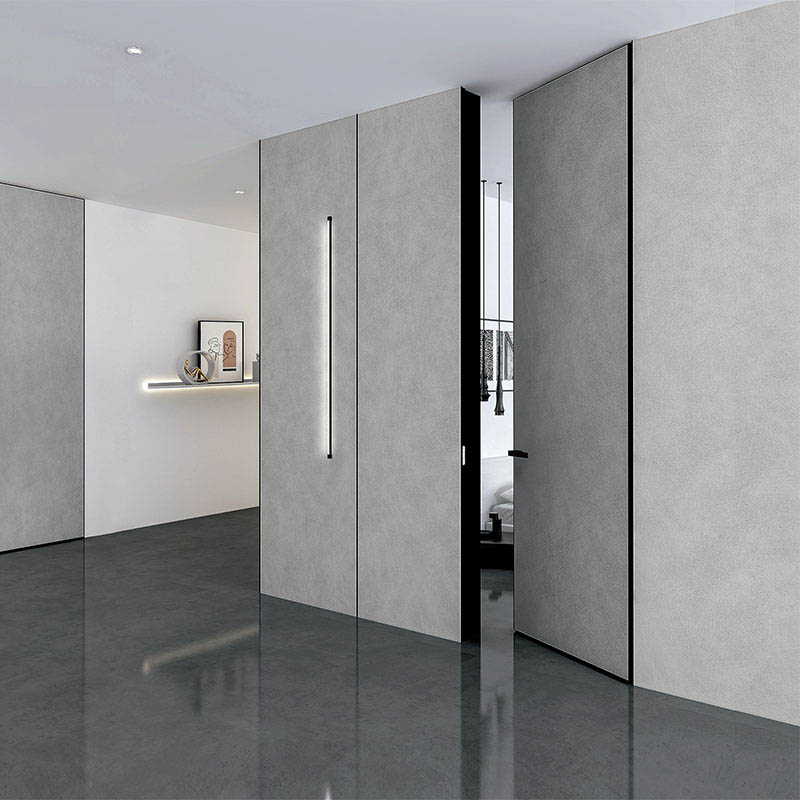
Its core lies in creating "visual continuity." Traditional bedroom doors are usually composed of multiple components such as the door leaf, door frame, and baseboard, with different materials, colors, and finishing methods often creating obvious visual interruptions, cutting the wall into fragmented blocks. Frameless doors completely eliminate the door frame, with the door panel edges flush with the wall finish. Combined with precise color matching—whether it's wood grain, solid color, or special paint—the door panel and adjacent wall panels are highly consistent in hue, gloss, and texture, making the boundary almost indistinguishable from a distance. When the door is closed, it's no longer "a door," but a complete, continuous extension of the wall. This seamless transition blurs the hard boundaries of functional areas, psychologically expanding the spatial scale, especially noticeable in small apartments.
Furthermore, concealed hinges and hidden locks push "de-decoration" to the extreme. Traditional door hardware such as metal hinges, lock cylinders, and handles, no matter how exquisite, are ultimately visual focal points, unconsciously attracting attention and disrupting the tranquility of the space. Frameless doors embed or cleverly conceal these functional elements: hinges are hidden inside the door side, locks use magnetic or embedded sliding mechanisms, and the surface only has minimal handle grooves or a completely handle-less design. The entire door surface is smooth and flat, without any protrusions or holes, like a meticulously polished art panel. This "invisible mechanism" allows the eye to flow freely, undisturbed by trivial details, thus creating a restrained yet sophisticated atmosphere of tranquility.
The reinforcement of spatial order by this design is equally important. Modern home design pursues the aesthetic logic of "less is more," emphasizing clean lines, harmonious proportions, and restrained elements. Frameless doors, with their clean straight edges, precise seams, and unified material language, become a key link in this system of order. They do not overshadow the space, but rather support the structural sense of the entire space with their rigorous craftsmanship and understated presence. When multiple doors throughout the house adopt a unified design language, a strong rhythm and cadence are created, making the flow of movement smooth and visually coherent. Residents experience the whole rather than just individual parts as they walk through it.
Furthermore, the tactile and acoustic experience of frameless doors also serves the theme of tranquility. The high-quality wood substrate is warm and skin-friendly, and the opening and closing process is often equipped with a buffer damping system, achieving easy opening with a gentle push and silent closing with a gentle push. There's no slamming sound as the door closes, only the gentle, quiet return to its place—a crucial element in private spaces like bedrooms and studies, safeguarding the tranquility needed for sleep and contemplation.
Of course, behind this "disappearance" lies an extremely high demand for installation precision and material stability. Frameless doors rely on the flatness of the wall itself and millimeter-level control during construction; even slight deviations can affect the closing effect and visual integrity. Therefore, it's not just a design choice, but a commitment to craftsmanship and quality.
In conclusion, the frameless wooden bedroom door's ability to minimize its presence and enhance spatial order and tranquility doesn't rely on ornate decoration, but rather on achieving "revelation" through "concealment"—by eliminating boundaries, hiding functions, and unifying materials, it allows the door to return to its essence: an operable wall, not an isolated piece of furniture. It doesn't speak, yet it makes the entire space clearer; it's understated, yet it defines the sophistication of modern living. In a noisy world, this "invisible door" is precisely the entrance to inner peace.
Its core lies in creating "visual continuity." Traditional bedroom doors are usually composed of multiple components such as the door leaf, door frame, and baseboard, with different materials, colors, and finishing methods often creating obvious visual interruptions, cutting the wall into fragmented blocks. Frameless doors completely eliminate the door frame, with the door panel edges flush with the wall finish. Combined with precise color matching—whether it's wood grain, solid color, or special paint—the door panel and adjacent wall panels are highly consistent in hue, gloss, and texture, making the boundary almost indistinguishable from a distance. When the door is closed, it's no longer "a door," but a complete, continuous extension of the wall. This seamless transition blurs the hard boundaries of functional areas, psychologically expanding the spatial scale, especially noticeable in small apartments.
Furthermore, concealed hinges and hidden locks push "de-decoration" to the extreme. Traditional door hardware such as metal hinges, lock cylinders, and handles, no matter how exquisite, are ultimately visual focal points, unconsciously attracting attention and disrupting the tranquility of the space. Frameless doors embed or cleverly conceal these functional elements: hinges are hidden inside the door side, locks use magnetic or embedded sliding mechanisms, and the surface only has minimal handle grooves or a completely handle-less design. The entire door surface is smooth and flat, without any protrusions or holes, like a meticulously polished art panel. This "invisible mechanism" allows the eye to flow freely, undisturbed by trivial details, thus creating a restrained yet sophisticated atmosphere of tranquility.
The reinforcement of spatial order by this design is equally important. Modern home design pursues the aesthetic logic of "less is more," emphasizing clean lines, harmonious proportions, and restrained elements. Frameless doors, with their clean straight edges, precise seams, and unified material language, become a key link in this system of order. They do not overshadow the space, but rather support the structural sense of the entire space with their rigorous craftsmanship and understated presence. When multiple doors throughout the house adopt a unified design language, a strong rhythm and cadence are created, making the flow of movement smooth and visually coherent. Residents experience the whole rather than just individual parts as they walk through it.
Furthermore, the tactile and acoustic experience of frameless doors also serves the theme of tranquility. The high-quality wood substrate is warm and skin-friendly, and the opening and closing process is often equipped with a buffer damping system, achieving easy opening with a gentle push and silent closing with a gentle push. There's no slamming sound as the door closes, only the gentle, quiet return to its place—a crucial element in private spaces like bedrooms and studies, safeguarding the tranquility needed for sleep and contemplation.
Of course, behind this "disappearance" lies an extremely high demand for installation precision and material stability. Frameless doors rely on the flatness of the wall itself and millimeter-level control during construction; even slight deviations can affect the closing effect and visual integrity. Therefore, it's not just a design choice, but a commitment to craftsmanship and quality.
In conclusion, the frameless wooden bedroom door's ability to minimize its presence and enhance spatial order and tranquility doesn't rely on ornate decoration, but rather on achieving "revelation" through "concealment"—by eliminating boundaries, hiding functions, and unifying materials, it allows the door to return to its essence: an operable wall, not an isolated piece of furniture. It doesn't speak, yet it makes the entire space clearer; it's understated, yet it defines the sophistication of modern living. In a noisy world, this "invisible door" is precisely the entrance to inner peace.