




How does a frameless wooden bedroom door achieve a seamless transition between the door and the wall/floor?
Release Time : 2026-01-12
In contemporary home design, people have higher demands for the integrity and visual purity of a space. While traditional framed wooden doors are functionally complete, the seams between the door frame, baseboard, and wall often create a noticeable "boundary," disrupting the continuity of the wall and weakening the sense of spaciousness. The emergence of the frameless wooden bedroom door is an elegant response to this problem—through minimalist construction and precise craftsmanship, the door appears to grow naturally from the wall, smoothly connecting with the floor to achieve a truly "seamless transition," creating a tranquil, coherent, and breathable living atmosphere.
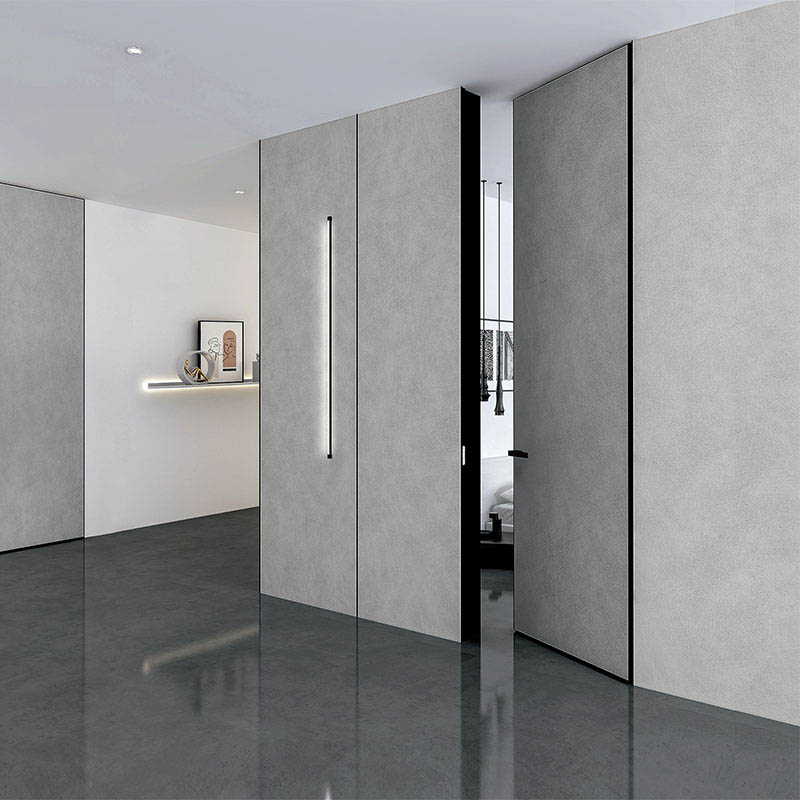
The core of the frameless wooden bedroom door lies in abandoning the traditional door frame and reconstructing the relationship between the door and the architectural interface. Frameless doors eliminate exposed door frames and side panels; the door leaf is directly embedded in a pre-drilled opening in the wall, with edges precision milled and chamfered to flush with the wall finish (such as latex paint, microcement, or wall panels). During installation, the door is fixed to the wall structure using concealed hinges or embedded hinges, leaving only a thin gap visible on the outside. This can be further minimized by using flexible edge trim or matching grout. In this way, the door is no longer a separate component "mounted on the wall," but rather part of the wall's texture, allowing for unobstructed visual extension and making small spaces appear more open.
Even more ingenious is the seamless integration with the floor. Frameless doors typically feature a floor-to-ceiling design, with the bottom of the door precisely cut to maintain a minimal and uniform gap from the floor surface. Some high-end solutions also incorporate concealed thresholds or inlays made of the same material as the flooring, allowing the door's bottom profile to blend smoothly into the floor system. When the door is closed, a smooth vertical transition line is formed from the wall to the door and then to the floor, without any abrupt changes. This detail not only enhances the overall aesthetics but also reduces hard-to-clean areas, facilitating daily cleaning.
Achieving this seamless effect requires meticulous control over material stability and installation precision. Natural wood is susceptible to expansion and contraction due to temperature and humidity fluctuations. Improper handling can lead to uneven door gaps or even jamming. Therefore, high-quality frameless wooden doors often use multi-layered composite substrates or rigorously dried and shaped solid wood engineered timber, ensuring a stable internal structure. The surface is covered with high-density wood veneer or environmentally friendly finishes, balancing natural grain with resistance to deformation. Furthermore, installation requires experienced technicians to ensure the wall opening is square, the floor is level, and the hinge embedment depth and door verticality are precisely adjusted to achieve a perfect fit and smooth opening and closing.
In addition, color and material consistency are key to a seamless visual appearance. Door surfaces often use matte white, light gray, or natural wood tones similar to the walls, and can even be customized to match the wall panels or flooring, further blurring the boundaries. When light passes over the wall, the door's presence is subtly diminished, leaving only the warmth of the material itself and the subtle interplay of light and shadow.
Ultimately, the seamless transition of a frameless wooden bedroom door with walls and floors is not simply a matter of "removing the door frame," but rather a systematic integration of proportion, craftsmanship, materials, and aesthetics. It uses a restrained design language to eliminate the disconnect between functional components and the architectural interface, allowing the door to become a "breathing space" rather than a "symbol of partition." When a door can quietly "disappear," the tranquility and completeness of the home truly emerge—this is the profound philosophy of frameless beauty: less artifice, more naturalness.
The core of the frameless wooden bedroom door lies in abandoning the traditional door frame and reconstructing the relationship between the door and the architectural interface. Frameless doors eliminate exposed door frames and side panels; the door leaf is directly embedded in a pre-drilled opening in the wall, with edges precision milled and chamfered to flush with the wall finish (such as latex paint, microcement, or wall panels). During installation, the door is fixed to the wall structure using concealed hinges or embedded hinges, leaving only a thin gap visible on the outside. This can be further minimized by using flexible edge trim or matching grout. In this way, the door is no longer a separate component "mounted on the wall," but rather part of the wall's texture, allowing for unobstructed visual extension and making small spaces appear more open.
Even more ingenious is the seamless integration with the floor. Frameless doors typically feature a floor-to-ceiling design, with the bottom of the door precisely cut to maintain a minimal and uniform gap from the floor surface. Some high-end solutions also incorporate concealed thresholds or inlays made of the same material as the flooring, allowing the door's bottom profile to blend smoothly into the floor system. When the door is closed, a smooth vertical transition line is formed from the wall to the door and then to the floor, without any abrupt changes. This detail not only enhances the overall aesthetics but also reduces hard-to-clean areas, facilitating daily cleaning.
Achieving this seamless effect requires meticulous control over material stability and installation precision. Natural wood is susceptible to expansion and contraction due to temperature and humidity fluctuations. Improper handling can lead to uneven door gaps or even jamming. Therefore, high-quality frameless wooden doors often use multi-layered composite substrates or rigorously dried and shaped solid wood engineered timber, ensuring a stable internal structure. The surface is covered with high-density wood veneer or environmentally friendly finishes, balancing natural grain with resistance to deformation. Furthermore, installation requires experienced technicians to ensure the wall opening is square, the floor is level, and the hinge embedment depth and door verticality are precisely adjusted to achieve a perfect fit and smooth opening and closing.
In addition, color and material consistency are key to a seamless visual appearance. Door surfaces often use matte white, light gray, or natural wood tones similar to the walls, and can even be customized to match the wall panels or flooring, further blurring the boundaries. When light passes over the wall, the door's presence is subtly diminished, leaving only the warmth of the material itself and the subtle interplay of light and shadow.
Ultimately, the seamless transition of a frameless wooden bedroom door with walls and floors is not simply a matter of "removing the door frame," but rather a systematic integration of proportion, craftsmanship, materials, and aesthetics. It uses a restrained design language to eliminate the disconnect between functional components and the architectural interface, allowing the door to become a "breathing space" rather than a "symbol of partition." When a door can quietly "disappear," the tranquility and completeness of the home truly emerge—this is the profound philosophy of frameless beauty: less artifice, more naturalness.