




How to design the opening angle of a thermal break casement window inward opening?
Release Time : 2026-02-10
The design of the opening angle of a thermal break casement window with inward opening requires comprehensive consideration of factors such as ventilation efficiency, safety, spatial adaptability, sealing performance, and overall architectural harmony. A scientific plan is needed to achieve a balance between function and aesthetics. Its design logic not only concerns the performance of a single window but is also closely related to the building environment, user habits, and safety regulations, requiring a systematic analysis from multiple dimensions.
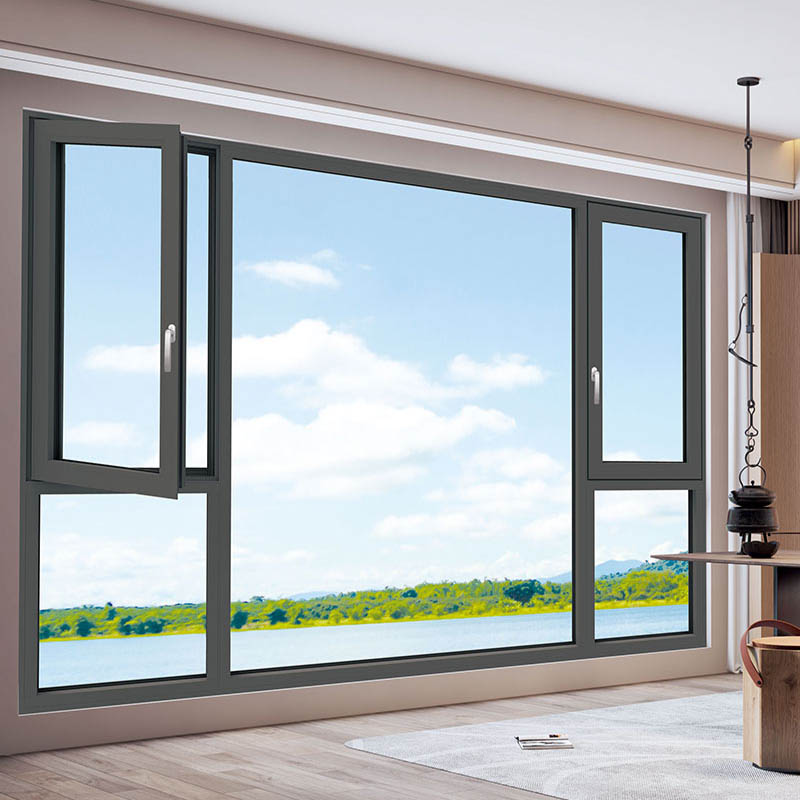
Ventilation efficiency is one of the core objectives of opening angle design. A reasonable opening angle must ensure effective convection between indoor and outdoor air, avoiding poor ventilation due to an excessively small angle or turbulent airflow due to an excessively large angle. Inward-opening casement windows typically use a 90-degree inward opening design. At this angle, the window sash is fully opened, creating the maximum ventilation area, but adjustments need to be made based on window size and room layout. For example, in a long and narrow room, appropriately reducing the opening angle can guide airflow along a specific path, improving ventilation uniformity; while in large spaces or scenarios requiring rapid air exchange, priority should be given to ensuring the maximum opening range to enhance air exchange efficiency.
Safety is a rigid constraint in opening angle design. Inward-opening windows may occupy interior space when open, and should be designed to avoid interfering with furniture, curtains, or human movement. The safe opening range should be determined based on the interior ceiling height, windowsill height, and furniture layout. It is generally recommended that the opening angle not exceed 75 degrees to prevent collisions or accidental bumps to the window edge. Furthermore, child safety must be considered, and the risks during opening should be reduced through limiting devices or anti-collision designs. For example, soft corner protectors can be added to the window edges, or multiple opening positions can be set to balance ventilation needs and safety.
Spatial adaptability is a practical principle for opening angle design. Different building types have different requirements for window opening angles. For example, high-rise residential buildings need to avoid windows swinging outwards and occupying public space, while low-rise buildings or villas can adjust the angle more flexibly. While inward-opening designs solve the safety hazards of outward-opening windows, the impact on indoor lighting, views, and activity space after the window is opened still needs to be considered. During the design phase, the opening trajectory can be optimized by simulating the distribution of light and shadow and space occupancy at different angles. For example, a top-hung, inward-opening design can achieve both ventilation and lighting within a limited angle, while minimizing interference with the interior layout.
Sealing performance is an implicit requirement of the opening angle design. The core advantage of thermally broken windows lies in their sealing structure, and the opening angle directly affects the compression and contact area of the sealing strip. The design must ensure that the window sash forms a uniform sealing pressure with the window frame when closed, preventing deformation or detachment of the sealing strip due to excessive opening angle. Multi-layer sealing designs are typically used, combined with an adjustable hinge system, to maintain the elasticity of the sealing strip during opening, for example, gradually releasing sealing pressure within a range of 45 to 90 degrees, ensuring both ventilation and maintaining thermal insulation performance.
Overall architectural harmony is an aesthetic consideration in the opening angle design. The window sash opening angle must match the building's facade style, window proportions, and surrounding environment to avoid abrupt angles that disrupt the overall visual effect. For example, modern minimalist architecture tends to combine large fixed windows with small-angle opening windows, achieving an "invisible" opening effect through concealed hinges; while traditional style architecture may use wood-grain materials and retro hinge designs, making the opening angle an extension of architectural details. During the design process, 3D modeling and rendering simulations are needed to verify the integration of the opening angle with the building facade, ensuring a unity of function and aesthetics.
From user habits to safety regulations, from ventilation requirements to sealing technology, the design of the opening angle of a thermal break casement window inward opening needs to find the optimal solution among multiple constraints. Through material innovation, structural optimization, and intelligent control, modern windows can now achieve precise angle adjustment and adaptive control. For example, electric hinge systems can automatically adjust the opening range according to indoor and outdoor environments, or achieve rain and wind sensing closure through sensor linkage. These technological advancements not only improve ease of use but also shift the opening angle design from "experience-driven" to "data-driven," making personalized customization and refined design possible.
A reasonable opening angle design is a comprehensive embodiment of function, safety, aesthetics, and technology. It needs to meet basic ventilation requirements while also considering space utilization, sealing performance, and architectural harmony, and enhance user experience through innovative design. With the development of green building and smart homes, the opening angle design of thermal break casement windows inward opening will place greater emphasis on humanization and intelligence, creating a more comfortable, safe, and efficient indoor environment for modern life.